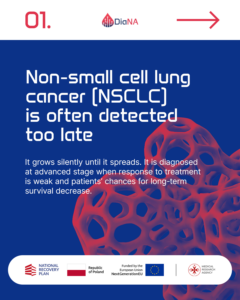
Lung cancer remains one of the greatest challenges in modern medicine and is the leading cause of cancer-related deaths among both men and women worldwide. Approximately 85% of all lung cancer cases are classified as non-small cell lung cancer (NSCLC). One of the key reasons for the high mortality associated with this disease is that it is often diagnosed at an advanced stage, when treatment options become more limited and less effective.
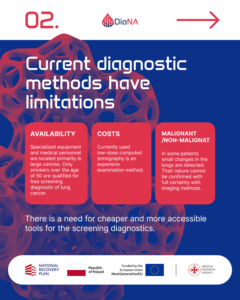
Although diagnostic pathways have improved significantly over the years, there is still a need for solutions that support earlier, more accessible, and less invasive detection of cancer-related changes.
To address this challenge, the International Centre for Cancer Vaccine Science (ICCVS), University of Gdańsk, has been implementing the NSCLC Diagnostics – Algorithm (DIANA) project since October 2024 under the leadership of Prof. Natalia Marek-Trzonkowska.
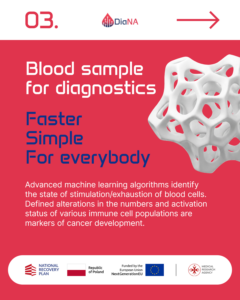
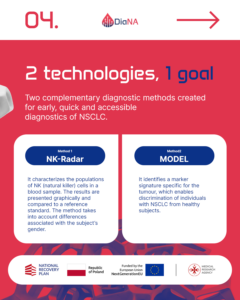
The goal of the project is to develop a novel diagnostic method for non-small cell lung cancer based on the analysis of a blood sample. The approach under development is designed to support early lung cancer screening through the use of two diagnostic algorithms: NK-Radar and MODEL.
The algorithms being developed by the ICCVS team use information about the activation status of the patient’s immune system (NK-Radar) and identify unique tumour characteristics, known as markers, in the blood of cancer patients (MODEL).
The technology developed within the project is intended to simplify lung cancer detection, increase access to diagnostic testing, and contribute to improving the efficiency, accessibility, and quality of healthcare systems. Another important objective of the project is to simplify both diagnostic procedures and result interpretation through the use of machine learning and artificial intelligence.
The long-term ambition of the DIANA project is to help extend and improve the quality of life of cancer patients while supporting the development of a more effective healthcare system.
As the project approaches its conclusion, the ICCVS team is preparing to share further information about the technologies developed within the project, research outcomes, and key findings.